



A nervous system–focused approach to self-care without pressure
The start of a new year often brings resolutions, goals, and expectations to improve ourselves. But for many people, these goals don’t create motivation. They activate stress.
If you’ve lived with chronic stress, emotional overwhelm, or relational wounds, your nervous system may experience goals as pressure rather than possibility. From a neuroscience perspective, this response makes sense.
Lasting change does not come from forcing yourself to do more.
It comes from creating enough internal safety for your nervous system to soften. Instead of setting goals that pull you away from yourself, this article offers gentle ways to care for your nervous system, support emotional regulation, and reduce self-abandonment.
These are not goals to achieve.
They are internal agreements to relate to yourself with more care.
Why traditional goals often dysregulate the nervous system
When the nervous system has learned to survive through hypervigilance, self-control, or emotional suppression, self-improvement can feel threatening. In survival states, the body is not focused on growth or expansion. It is focused on protection.
This is why motivation often disappears under pressure.
It’s not a lack of discipline.
It’s a biological response.
Before asking more from your mind and pushing yourself to do more, to be more, you have to make sure your nervous system is safe.
10 Gentle Ways to Care for Yourself This Year
Taking care of yourself doesn’t always mean making big changes or pushing yourself harder. Often, it means ceasing to fight against your body and starting to listen to it more honestly. These kinds of ways to take care of yourself aren’t goals you have to achieve; they’re reminders to build more inner security, regulate your nervous system, and support yourself in a more humane way throughout the year.
Supporting nervous system regulation and emotional well-being
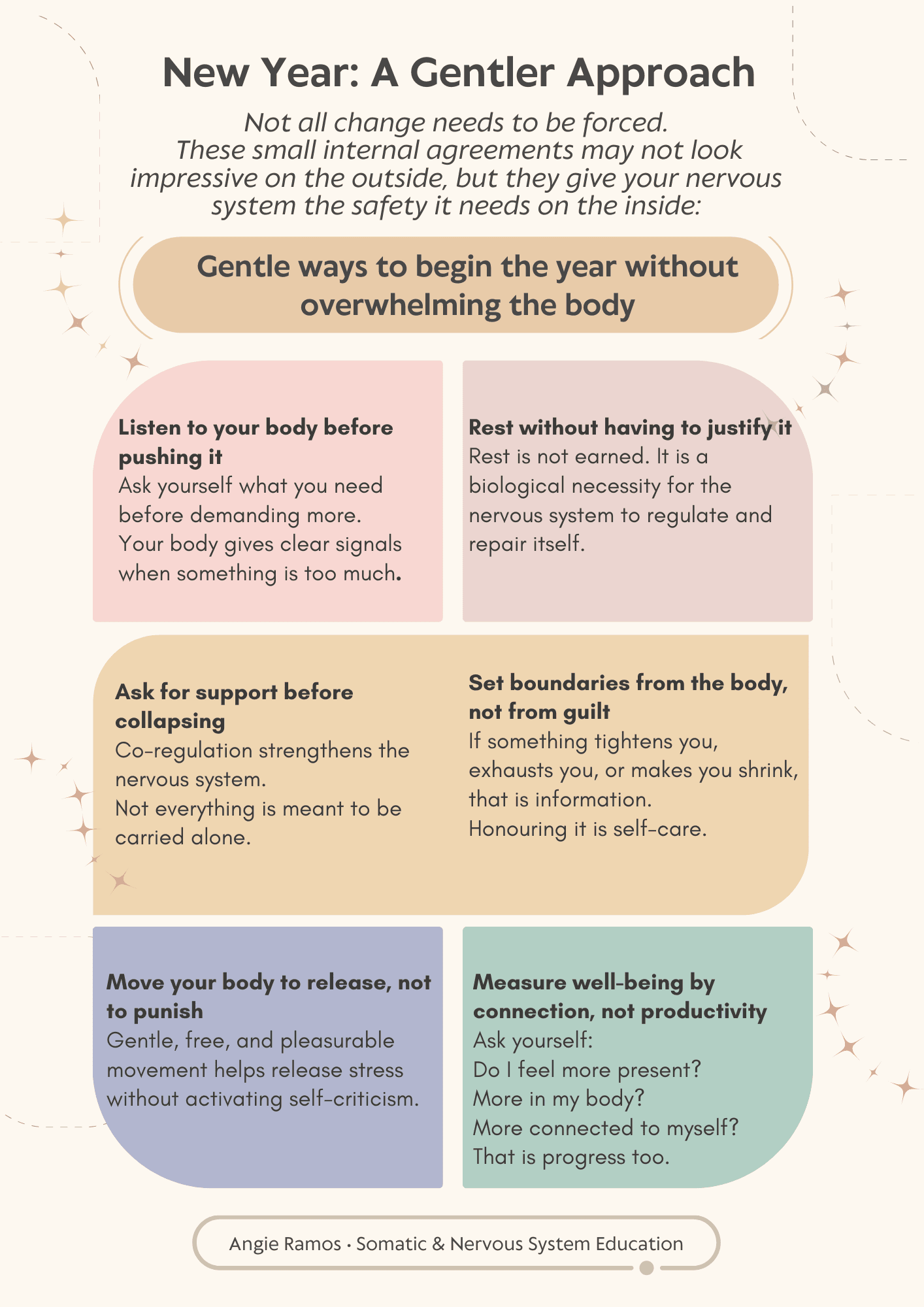
1. Listen to Your Body Before Pushing It
For a long time, we were taught to ignore our bodies to achieve more. But the body doesn’t make mistakes. Tension, fatigue, disconnection, or irritability aren’t obstacles; they’re messages from our nervous system.
Listening to your body involves pausing and asking yourself:
Is this tiredness or resistance?
Do I need to push or do I need to hold on?
What do I really need?
When you learn to respond instead of forcing things, your nervous system stops being in constant alert; you can give yourself rest, food, company, and some time alone.
It’s not just about listening, but about attending to your needs properly, and this is what helps you build inner security and reduces emotional exhaustion.
2. Rest without guilt
Rest isn’t a reward for being productive. It’s a biological necessity. A nervous system that doesn’t get enough rest remains activated, reactive, and vulnerable to stress.
Rest without guilt means ceasing to justify your need to stop. It means recognizing that the body needs real breaks to integrate experiences, process emotions, and regain balance.
Not resting doesn’t make you stronger. It keeps you in survival mode.
3. Smooth your transitions throughout the day
Moving from one activity to another without a break keeps the nervous system in a constant state of urgency. Abrupt transitions increase activation, even if you’re not consciously aware of it.
Smoothing your transitions can be as simple as taking a deep breath before switching tasks, stretching for a few minutes, or mentally closing out what you just did.
These small pauses allow you to connect with your body and listen to it.
4. Ask for support before you break down
The human nervous system is regulated in relation to others. The idea that “I can handle everything on my own” is usually an early adaptation, not a true strength.
Asking for support before reaching your limit reduces overload and prevents states of emotional numbness, exhaustion, or disconnection.
We cannot heal everything in isolation. Co-regulation is not dependency; it is a basic need of the nervous system and a powerful way in which we can heal.
5. Set boundaries from your body, not from guilt
Many people try to set boundaries in their minds, but their bodies have already set them. Discomfort, tension, or exhaustion are clear signs that something is unsustainable.
Learning to listen to these signals and act accordingly is a profound form of self-care. You don’t need to justify every boundary or over-explain yourself.
Remember that boundaries are something you set for yourself, not something others should do. I believe that one of the most important steps when we talk about boundaries is learning to respect them ourselves. In other words, if something makes me feel unwell, I have to do what I’ve established, like talking about it, stepping away, or taking a break. Whatever action is appropriate for each situation, we have to learn to respect it.
A boundary isn’t rejection. It’s a resource that allows us to take care of ourselves and create a safe space, both emotionally and physically.
6. Move your body to release, not to punish it.
Movement doesn’t have to be intense or corrective to be effective. The body needs to release accumulated energy, not be forced.
Gentle, conscious, and pleasurable movement helps release stress, regulate emotions, and reconnect with the feeling of being present in your body.
Moving with respect changes the relationship you have with yourself and your body. This allows the body to stop being a project to be corrected and become your safe haven.
7. Respect low-energy days.
Emotional regulation isn’t linear. There will be days of clarity and others of withdrawal. Forcing yourself to perform at the same level every day goes against the biology of our nervous system.
Respecting low-energy days doesn’t mean giving up or being lazy; it means we can allow ourselves to take care of our bodies, helping us regain energy and motivation so we can then accomplish what we want.
Stability is built by honouring cycles, not denying them.
8. Validate what you feel before trying to change it.
Validation helps calm our amygdala and reduces our activation response. When you try to change what you feel without validating it first, it keeps you activated.
Telling yourself, “It makes sense that I feel this way,” doesn’t reinforce the discomfort. It contextualizes it. It gives the body the signal that it no longer needs to fight to be heard.
Without validation, there is no regulation. Without regulation, there is no sustainable change.
9. Choose relationships where you don’t have to disappear.
Your nervous system needs consistency, predictability, and presence. Having to minimize yourself, stay silent, or constantly adapt to avoid losing a connection keeps your body on high alert.
Safe relationships don’t require you to disappear to belong. They allow you to exist fully, just as you are.
Choosing more regulating environments isn’t selfishness or immaturity. It’s emotional hygiene.
10. Measure well-being by connection, not productivity.
Many people measure their worth by what they do, not by how they feel. But the nervous system doesn’t understand lists or achievements; it understands sensations.
Ask yourself more often:
Do I feel more present?
Do I feel more in my body?
Do I treat myself with more kindness?
That’s also progress. Sometimes, it’s the most important kind.

Nervous system–based self-care is about safety, not effort
Caring for yourself does not mean doing more.
It means doing less harm to your nervous system.
When the body feels safe, change happens naturally. This year does not need to begin with pressure. It can begin with a gentler, more supportive relationship with yourself.
Sometimes the most powerful shift is simply stopping the fight against your own body.